
FBA Reimbursement Recovery Service — 10-25% Commission
Get the money Amazon already owes you.
14-day free trial · No credit card required · Cancel anytime
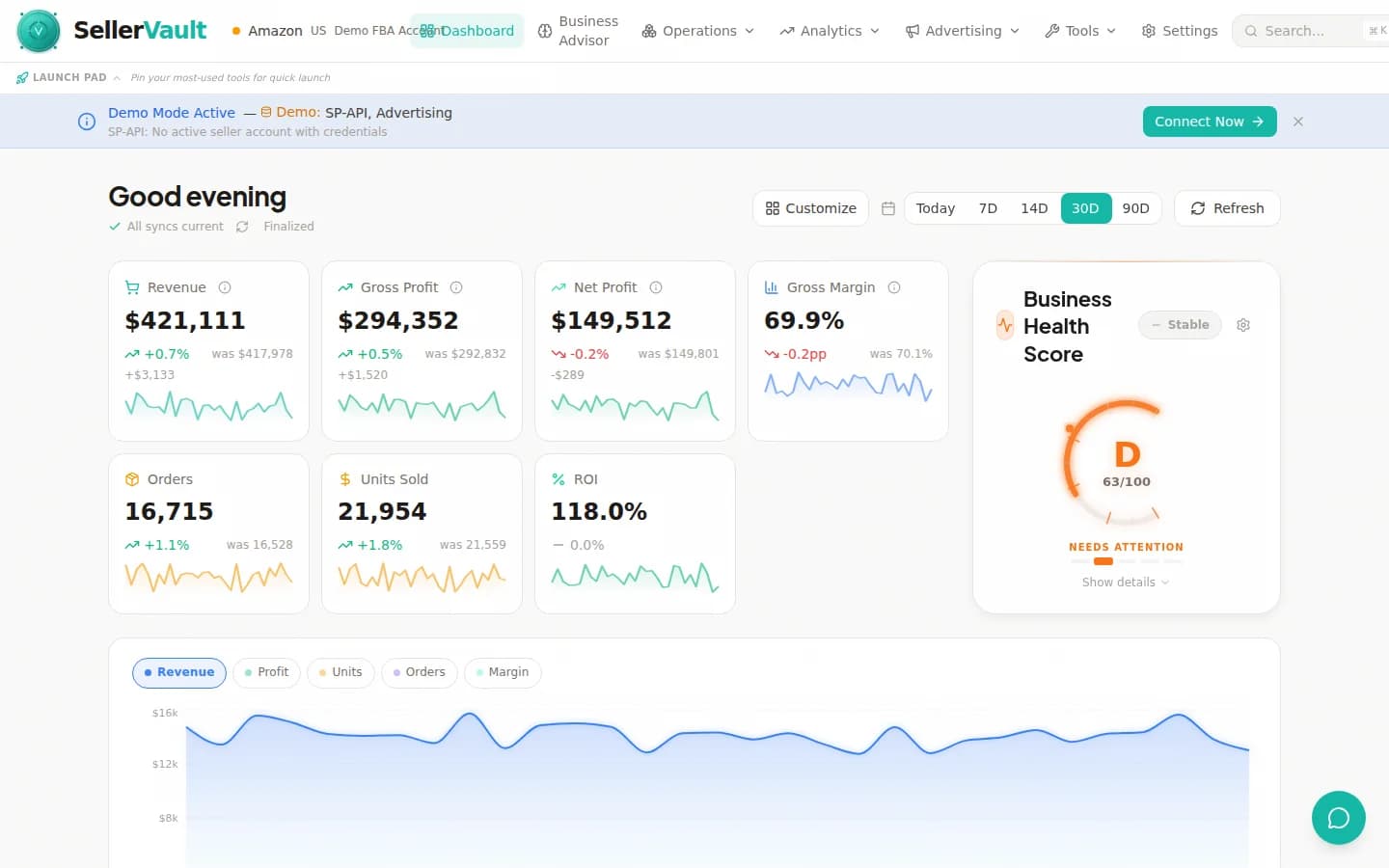
Reimbursement detection flows into your main dashboard alongside inventory, profit, and repricing — no separate portal to manage.
Watch discrepancies surface
Our audit engine runs continuously across your full claimable history. Here's an illustrative example of what it surfaces.
10+ automated discrepancy detection algorithms
SellerVault's audit engine runs 10 distinct detection algorithms across your historical FBA data: inbound shortages, inbound damage, warehouse lost inventory, warehouse damaged inventory, customer returns (missing/wrong item/damaged), 60-day return rule violations, refund overcharges, fee overcharges (weight/dimension errors), and removal order discrepancies. Every eligible claim is found.
- Inbound shipment shortages (full historical lookback)
- Warehouse lost and damaged inventory
- Customer returns: missing, wrong item, damaged
- 60-day return rule automated monitoring
- Refund overcharges and fee audit (weight/dimension)
- Removal order discrepancies
Low commission (10-25%) vs industry-standard 25% flat
Most FBA reimbursement services charge 25% flat across the board. SellerVault's commission is tiered by plan: Enterprise 10%, Agency 12%, Professional 15%, Growth 20%, Starter 25%. High-volume sellers pay dramatically less. There's no upfront fee — commission is only taken on funds actually recovered to your Seller Central balance.
- Tiered commission: 10% Enterprise, 12% Agency, 15% Pro, 20% Growth, 25% Starter
- No upfront cost — we only get paid when you get paid
- Monthly invoicing with full recovery breakdown
- Transparent per-claim attribution (no hidden fees)
TOS-compliant managed claim filing (no automation)
Amazon explicitly prohibits automated claim submission. SellerVault's reimbursement service uses a trained virtual assistant team to file claims manually through your Seller Central account using the pre-written case templates our audit engine generates. No automation on the submission side, no TOS risk, no account suspension concerns.
- Virtual assistant team files manually (100% TOS-compliant)
- Pre-written case templates with evidence attached
- Priority queues for high-value and urgent claims
- Manual review before filing to prevent false positives
Full claim-window lookback
Amazon has different filing windows for different claim types: 60 days for inbound shipment issues, 60 days for warehouse losses (auto-reimbursed by Amazon after 30 days otherwise), a 60-day wait then a 120-day deadline for customer returns, and 90 days for fee overcharges. SellerVault's audit job respects every deadline and prioritizes claims heading toward expiration.
- Full historical inbound lookback on first audit
- Deadline-aware claim prioritization
- Auto-reimbursement detection (don't double-file)
- Background audit jobs with progress tracking
Recovery analytics and audit history
Every claim SellerVault prepares is tracked end-to-end: detected → reviewed → filed → Amazon response → recovered amount. You see total recovered funds, open opportunities, claim success rates, and team throughput at any time. When tax season comes around, the recovered-amount history exports to CSV in one click.
- Recovered amount tracking per claim, SKU, and time period
- Success rate analytics (filed vs approved)
- Commission ledger with monthly statements
- Full audit history exportable to CSV
Case evidence auto-generated from SP-API
Amazon requires evidence for every claim: shipment IDs, dates, quantities, financial amounts. SellerVault pulls this directly from the SP-API and formats it into case-ready templates. Your VA copy-pastes into Seller Central — they don't have to hunt for evidence, calculate amounts, or write case narratives from scratch.
- Evidence pulled directly from SP-API reports
- Pre-formatted case narratives with all required fields
- Shipment IDs, dates, and amounts auto-populated
- Per-discrepancy-type templates refined over thousands of cases
Frequently asked questions
How much money could Amazon owe me in FBA reimbursements?
The typical FBA seller has 1-3% of annual revenue tied up in reimbursement-eligible discrepancies that were never automatically corrected. For a $1M seller that's $10,000-$30,000. For an 8-figure seller it's six figures. SellerVault's audit engine goes back through your full claimable history on your first run, so the initial recovery is usually the largest.
How is SellerVault's reimbursement service different from Getida, Refunds Manager, or SellerInvoice?
Three things: (1) Lower commission — we tier from 10% to 25% based on plan, while Getida and most competitors charge a flat 25%. High-volume sellers save the most. (2) Built into the platform you already use — no bouncing between a separate service and your inventory tool. Discrepancies detected by our audit engine flow directly into your normal workflow. (3) The audit engine runs continuously, not just on a quarterly batch. New discrepancies are surfaced within 24 hours of becoming eligible.
Is automated claim submission safe? Will Amazon suspend my account?
We don't use automated claim submission because Amazon's Terms of Service explicitly prohibit it. Any service that claims to submit claims automatically is putting your account at risk. SellerVault uses a trained VA team to file claims manually through your Seller Central account using pre-written case templates our audit engine generates. This is 100% TOS-compliant and is how every reputable reimbursement service operates.
What categories of reimbursements do you detect?
Ten categories: inbound shipment shortages, inbound shipment damage, warehouse lost inventory, warehouse damaged inventory, customer return missing (60-day rule violations), customer returns with wrong item, customer returns with damaged item, refund overcharges, fee overcharges (weight/dimension errors), and removal order discrepancies. We don't detect chargebacks or A-to-z claims — those require manual review of customer correspondence.
How long does it take to get reimbursed after filing a claim?
Amazon's typical response time is 3-7 days for simple claims (inbound shortages, removal discrepancies) and 2-4 weeks for complex claims (customer returns, fee overcharges). Once approved, the reimbursement lands in your Seller Central balance within 48 hours. SellerVault tracks every claim and updates its status when Amazon responds.
Do you handle claim denials or escalations?
Yes. When Amazon denies a claim, our VA team reviews the denial reason, determines if it's a valid rejection or a filing error, and escalates disputed denials with additional evidence. Escalations are usually resolved within 2-3 rounds of correspondence. We track the success rate of escalations so you can see our track record.
Is there an upfront cost or minimum commitment?
No upfront cost. Commission is only deducted from funds Amazon actually credits back to your account. No minimum commitment — you can cancel your SellerVault subscription at any time and any open claims already filed will continue to be worked until resolution. There's also a 30-day money-back guarantee on the subscription itself.
Can I review claims before they're filed?
Yes. By default, claims above $500 require your approval before filing. Claims below that threshold are filed automatically by our VA team (since the time cost of manual review would exceed the claim value). You can adjust the approval threshold up or down in your settings. For paranoid sellers, we support a "review everything" mode.
The average FBA seller has $10K+ in uncollected reimbursements right now.
Your first audit covers your full claimable history. We only get paid when you do.
Master FBA reimbursements
Claim categories, deadlines, evidence requirements, and how to file SAFE-T claims.
The Complete Guide to Amazon FBA Reimbursements in 2026
Learn about every type of FBA reimbursement, filing deadlines, and how to streamline the discrepancy detection process.
Creating an Amazon FBA Shipment: The Complete Step-by-Step Guide
Walk through the entire FBA shipment process from selecting products to printing labels. Learn case pack setup, box content info, and how to avoid common receiving delays.
The Complete FBA Reimbursement Guide (2026)
Every category of FBA reimbursement, deadlines, evidence requirements, and how to file.
SAFE-T Claim
When to file a SAFE-T claim, eligibility, and how it differs from a normal reimbursement.
Stranded Inventory
What stranded inventory is and how to recover or remove it before storage fees compound.
SellerVault vs Getida
Reimbursement service comparison: commission, manual filing, and TOS compliance.